

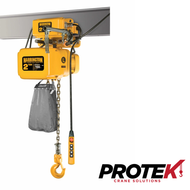
Why This 20-Ton Harrington Hoist Is Built for Heavy-Duty Performance
Most industrial lifting equipment handles light-to-medium loads adequately, but heavy industrial applications demand engineering precision that separates professional-grade systems from consumer products. The Harrington NERM200S-L Electric Chain Hoist with Motorized Trolley represents the upper end of Harrington's NERM series, delivering a 20-ton capacity and a 20-foot lift height for the most demanding manufacturing and heavy-industry applications.
What Makes This System Heavy-Duty
The NERM200S-L offers high lifting capacity and precision controls for industrial environments where downtime is costly. Its electric motor system enables both vertical lifting and horizontal trolley movement through integrated controls, eliminating manual handling for loads up to 40,000 pounds. Heavy-duty load chains and precision gearing ensure smooth operation under extreme weights. The motorized trolley moves along I-beams or similar structures, allowing full load positioning throughout your facility.
When You Need 20-Ton Capacity
Facilities handling extremely heavy components require this capacity. Steel mills use heavy-duty hoists for moving coils, billets, and finished products. Power generation plants deploy them for turbine maintenance and transformer positioning. Heavy equipment manufacturers rely on multi-ton hoists to assemble construction machinery, mining equipment, and industrial vehicles. Shipyards and marine facilities need high capacity for engine installation and structural fabrication. Foundries and forging operations manage castings and forgings that exceed standard hoist capacities.
Key Performance Features
A 20-ton lifting capacity enables applications that smaller equipment cannot handle, such as moving complete engine assemblies, industrial machinery, and structural steel components safely and efficiently. Precision controls allow operators to position heavy loads with inch-level accuracy. The integrated trolley removes the need for separate motorized systems, reducing installation complexity and ensuring coordinated lifting and traversing. Heavy-duty duty cycle capability supports continuous operation in production environments. Safety features, including overload protection and emergency stops, are essential when handling loads that could cause significant damage if a failure occurs.
Compare Heavy-Duty to Standard Hoists
Standard electric chain hoists typically handle 3 to 5 tons, which is insufficient for heavy manufacturing. Wire rope hoists offer higher capacities but require more headroom and are significantly more expensive than chain systems. Overhead bridge cranes provide maximum capacity and coverage but require extensive structural installation and significant capital investment. The NERM200S-L bridges the gap for operations needing substantial capacity without the need for full bridge crane infrastructure.
How to Specify the Right Heavy-Duty Configuration
Verify your maximum load by weighing your heaviest components, including rigging. Incorrect weight assumptions often reveal capacity issues during installation. Calculate total lift height, factoring in hook height, rigging length, and necessary clearance above the highest work position. Measure the beam dimensions to ensure trolley compatibility, and confirm that the structure can support the combined weight of the hoist, trolley, and the maximum load. Determine duty-cycle requirements; heavy-duty motors and components are essential for continuous operation. Specify control systems based on operator needs: pendant controls suit fixed positions, while radio controls offer flexibility in larger facilities.
FAQ: Heavy-Duty Hoist Operations
What structural support do I need for a 20-ton hoist?
Your beam and building structure must support the combined dead load of the equipment plus the maximum rated load, with appropriate safety factors—typically 125-150% of the combined weight.
How long do heavy-duty hoists last?
With proper maintenance, industrial electric hoists can operate reliably for 20-30 years under normal duty cycles.
Can I upgrade from a smaller hoist to this capacity?
Upgrading requires verifying that your structural supports, electrical service, and beam system can handle the increased loads—consult engineering professionals before upsizing.
Critical Mistakes in Heavy-Duty Applications
Structural inadequacy can cause catastrophic failures if buildings, beams, or supports cannot withstand the extreme loads these hoists generate. Underestimating the duty cycle leads to premature equipment failure when intermittent-duty models are used for continuous operation. Inadequate electrical service can cause issues when facilities lack the required three-phase power capacity. Skipping professional installation is hazardous; heavy-duty hoists require expert installation to ensure proper rigging, electrical connections, and safety system functionality.
Why ProTek Is Your Heavy-Duty Partner
ProTek's engineering team has decades of experience specifying and installing heavy-duty lifting systems for industrial applications. They offer comprehensive load analysis, structural evaluation, and system design to ensure your installation meets safety and operational standards. With access to the full Harrington industrial hoist lineup and supporting infrastructure, ProTek delivers complete turnkey solutions backed by expert service.
Your heavy-lifting challenges demand professional-grade solutions—request a consultation with ProTek to get a customized NERM200S-L system engineered specifically for your operation.