

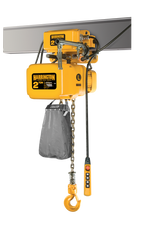
Why Speed Selection Matters More Than Most Buyers Realize
When purchasing a NERM electric chain hoist with a motorized trolley, many buyers focus first on capacity and lift height. While those factors are important, hoist and trolley speeds play a major role in productivity, operator control, and safety. Selecting the proper speed configuration ensures a smoother workflow, minimizes load swing, and improves positioning accuracy. Protek Crane Solutions helps customers evaluate these performance details so their lifting equipment supports real operational goals rather than creating unnecessary challenges.
Understanding Hoist Speed
Single speed hoists for straightforward lifting
Single speed hoists operate at a consistent lifting rate, making them a practical choice for repetitive lifting tasks where precision positioning is less critical. These units are often selected for simple vertical lifting applications such as moving parts between stations, loading materials, or handling packaged goods. They provide dependable performance while typically offering a lower upfront investment.
Single speed configurations also reduce complexity for operators who perform frequent lift and lower cycles without needing fine adjustment. This makes them suitable for maintenance areas, small fabrication shops, and general warehouse operations.
Dual speed hoists for precision and control
Dual speed hoists introduce a slower secondary speed that allows operators to position loads more accurately. This slower setting is particularly helpful during final placement, delicate assembly work, or when handling fragile components. The faster primary speed maintains productivity during travel while the slow speed enhances precision.
NERM dual speed hoists utilize variable frequency drive technology, which enables gradual acceleration and deceleration. This feature reduces shock loading and minimizes unwanted load movement. According to the product specifications, adjustable speed ratios provide flexibility for tailoring performance to specific applications.1ftfuxzghb_Electric_Chain_Hoist…
Understanding Trolley Speed
Single speed trolley movement
Single speed trolleys move the hoist along the beam at a fixed rate. This configuration is effective when horizontal travel distances are short or when operators do not require precise positioning along the beam. Many light-duty applications benefit from this simplicity, especially when loads are consistently placed in similar locations.
For facilities that prioritize reliability and ease of use, single speed trolley options can provide excellent value without sacrificing smooth operation.
Dual speed trolley movement
Dual speed trolley systems add a slower travel speed for fine positioning. This capability becomes valuable when loads must be placed with accuracy or when the work area includes multiple placement points along the beam. The slower speed allows operators to approach the final position with confidence, reducing overshoot and minimizing correction movements.
The MR motorized trolley used in NERM hoists incorporates a programmable variable frequency drive that provides smooth starts and stops. This results in controlled travel and reduced load sway during beam movement.1ftfuxzghb_Electric_Chain_Hoist…
Matching Speed Choices to Your Application
High productivity workflows
Facilities that prioritize throughput often benefit from faster primary hoist and trolley speeds. Manufacturing lines, shipping departments, and repetitive-lifting environments can achieve higher speeds to reduce cycle times. In these scenarios, dual-speed configurations still provide value by enabling controlled final placement without sacrificing overall productivity.
Precision handling environments
Applications involving delicate components, assembly work, or high-value materials typically require slower secondary speeds for accurate positioning. Dual speed hoists and trolleys provide the control needed to prevent sudden movements and reduce the risk of damage.
Mixed duty environments
Many operations fall between these extremes. Mixed-duty workflows benefit from dual-speed capability because it offers greater flexibility. Operators can move quickly when appropriate while still maintaining precision when required. This adaptability often makes dual speed configurations the preferred long-term investment.
Operational Benefits of Proper Speed Selection
Improved safety
Gradual acceleration and deceleration reduce load swing and minimize sudden movement. This improves operator confidence and decreases the risk of accidents.
Reduced equipment wear
Controlled movement lessens mechanical stress on chains, gears, and supporting structures. Over time, this contributes to longer equipment life and lower maintenance costs.
Enhanced operator productivity
When operators can position loads efficiently without repeated adjustments, the workflow becomes smoother and less physically demanding. This translates into measurable productivity gains across shifts.
How Protek Crane Solutions Helps Buyers Decide
Choosing the right speed configuration requires understanding workflow, load characteristics, and facility layout. Protek Crane Solutions works with customers to evaluate these factors and recommend appropriate hoist and trolley combinations. Their guidance helps ensure that equipment performs as intended while avoiding unnecessary upgrades or limitations.
Making the Right Investment
Speed selection is not simply a technical detail. It is a strategic decision that affects productivity, safety, and operator satisfaction. NERM electric trolley hoists offer flexible speed configurations tailored to a wide range of applications. By working with Protek Crane Solutions, buyers gain access to expert insight and quality Harrington equipment that supports long-term operational success.
For organizations seeking efficient lifting with precise load control, understanding hoist speed and trolley speed options is the key to choosing a system that truly fits their needs.
See the Harrington Catalog for speed specs https://www.harringtonhoists.com/download/2021/02/09/1ftfuxzghb_Electric_Chain_Hoist_Catalog.pdf