

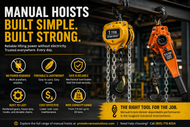
Even with modern powered lifting equipment available, manual hoists remain among the most commonly used tools in industrial lifting and rigging. Their simplicity, portability, and reliability make them practical for many applications where electric hoists are unnecessary or inconvenient.
1. They Work Without Electricity
One of the biggest advantages of manual hoists is that they require no external power source. This makes them ideal for:
- Remote job sites
- Outdoor construction work
- Emergency maintenance
- Field service operations
- Temporary lifting setups
Without a nearby power supply, a manual hoist can still get the job done safely and efficiently.
2. They Are Easier to Transport
Manual hoists are compact compared to electric hoists. Many smaller models fit directly into a tool bag, truck compartment, or maintenance cart.
This portability makes them popular with:
- HVAC technicians
- Millwrights
- Industrial maintenance crews
- Contractors
- Utility workers
A portable lifting solution can save valuable time when crews need to move quickly between job locations.
3. They Require Less Maintenance
Electric hoists contain motors, electrical components, wiring, and controls that require service or replacement over time. Manual hoists have fewer moving parts and simpler internal systems.
Routine maintenance usually consists of:
- Chain inspection
- Lubrication
- Hook inspection
- Brake testing
This simplicity often leads to lower long-term operating costs.
4. They Offer Excellent Load Control
Manual hoists let operators make slow, precise adjustments while lifting or positioning loads.
This is especially important when:
- Aligning machinery
- Positioning equipment
- Performing maintenance work
- Handling delicate installations
The operator keeps direct physical control over lifting speed and movement.
5. They Handle Harsh Environments Well
Industrial environments can be rough on powered equipment. Dirt, moisture, temperature changes, and debris may affect electric hoists over time.
Manual hoists are often better suited for:
- Dusty fabrication shops
- Outdoor construction sites
- Damp industrial facilities
- Remote environments
- Corrosive settings
Their simpler construction reduces potential failure points.
6. They are more cost-effective for Occasional Lifting
Not every facility needs an electric hoist daily. For occasional lifting tasks, a manual hoist may provide all the needed capability at a fraction of the cost.
This makes them a practical choice for:
- Small businesses
- Maintenance departments
- Repair facilities
- Agricultural operations
- Small fabrication shops
The lower purchase price and minimal upkeep make them a great value.
7. They Are Extremely Durable
Quality manual hoists are built using hardened steel gears, heavy-duty hooks, and durable load chains designed for repeated lifting cycles.
Many industrial users keep the same manual hoists in service for years, provided they receive proper maintenance and inspections.
That long service life is one reason manual hoists remain common across industrial workplaces.
Frequently Asked Questions About Manual Hoists
What is the difference between a hand chain hoist and a lever hoist?
A hand chain hoist is designed mainly for vertical lifting from an overhead position. A lever hoist uses a ratcheting handle and can pull loads horizontally, vertically, or at angles.
Are manual hoists safe for overhead lifting?
Yes, when used properly and within rated capacity. Quality manual hoists use mechanical load brakes that securely hold suspended loads in position until the operator intentionally lowers them.
How much weight can a manual hoist lift?
Manual hoists are available in capacities ranging from small fractional-ton models up to heavy-duty 20-ton industrial units.
Do manual hoists require regular maintenance?
Yes. Operators should routinely inspect chains, hooks, safety latches, and braking systems while lubricating moving parts in accordance with manufacturer recommendations.
Can a hand chain hoist be used horizontally?
No. Standard hand chain hoists are intended for vertical lifting only. Lever hoists are the proper choice for horizontal pulling or tensioning applications.
Why do some companies still prefer manual hoists over electric hoists?
Manual hoists are often preferred because they are portable, reliable, cost-effective, and can operate without electricity. In many environments, they are simply the more practical tool.
How do I choose the correct manual hoist capacity?
A hoist should always be rated above the maximum expected load. Many professionals recommend selecting a hoist with at least 25% more capacity than the heaviest planned lift.
Where can I browse manual hoists for industrial lifting applications?
You can browse the full selection of manual lifting equipment in the manual hoist category from Protek Crane Solutions.