

When your crew spends hours each day manually positioning heavy loads, fatigue becomes a massive productivity killer and an undeniable risk of injury. The question is not whether you need lifting equipment. It is whether manual operation still makes sense or if powered systems deliver a better return on investment.
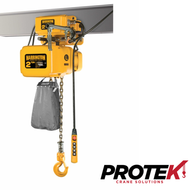
The HARRINGTON NERM001H ELECTRIC CHAIN HOIST WITH MOTORIZED TROLLEY eliminates the manual effort equation. This system delivers both vertical lifting and horizontal trolley movement via reliable electric power for capacities ranging from 1/8 ton to multiple tons.
Understanding the Integrated System
The Harrington NERM series combines an electric chain hoist with an integrated motorized trolley, providing complete three-dimensional load positioning without any physical pulling or pushing. Operators control vertical lifting and horizontal beam travel through pendant push-button controls or optional radio remote systems.
The electric motor drives both the lifting mechanism and the trolley wheels, moving loads precisely where you need them across the full beam span. This system removes the need to purchase separate hoist and trolley components while guaranteeing matched performance and a much simpler installation process.
Where Electric Lifting Systems Excel
High-volume operations gain the most from electric hoists. Manufacturing assembly lines use them for repetitive component positioning where speed and consistency matter far more than the initial equipment cost. Warehouses handling heavy freight deploy electric systems to reduce operator exhaustion during continuous lifting cycles.
Maintenance operations in power plants, mills, and industrial facilities rely heavily on motorized hoists for positioning large equipment during repairs. Steel fabrication shops need the sheer exactness and power that electric systems provide for handling structural components. Ultimately, any operation that lifts dozens of loads daily will see a faster return on investment from electric systems than from manual alternatives.
Key Benefits That Transform Operations
- Massive Productivity Gains: Electric hoists lift and position loads five to ten times faster than manual systems while eliminating operator fatigue.
- Pinpoint Precision: Variable-speed controls enable inch-by-inch positioning that is virtually impossible when manually pulling a chain.
- Enhanced Safety: Operators can control loads from a safe distance using pendant or radio controls, rather than standing directly under suspended loads.
- Simple Capacity Scaling: Adding more lifting capability requires only a larger motor, not exponentially more human physical effort.
- Multiplied Labor Efficiency: One operator can manage multiple hoists or perform other tasks while the hoist moves loads automatically.
Comparing Electric and Manual Lifting Solutions
Manual chain hoists cost significantly less upfront and work anywhere without needing a dedicated power infrastructure. They excel at occasional lifting in remote locations or applications where lifting occurs only a few times per day.
Electric systems like the HARRINGTON NERM001H ELECTRIC CHAIN HOIST WITH MOTORIZED TROLLEY demand a greater upfront investment and require electrical service at the installation point. However, operations that lift continuously throughout shifts recoup the cost difference within months through labor savings and significant productivity gains. The motorized trolley adds yet another layer of efficiency. Manual trolleys require pushing, which slows operations and tires workers, whereas motorized travel occurs instantly at the press of a button.
Frequently Asked Questions About Electric Hoists
What power requirements do I need? Most electric chain hoists operate on standard 230V or 460V three-phase power, though single-phase options do exist for smaller capacities.
How do I choose between pendant and radio controls? Pendant controls cost less and work perfectly when operators stay near the hoist. Radio controls provide the ultimate freedom to operate the machinery from anywhere within visual range.
What maintenance do electric hoists require? You should expect to perform periodic inspections of electrical components, brake systems, and load chains. We recommend professional service annually or as determined by your specific duty cycle.
Choosing the Right Configuration for Your Facility
Start by calculating your maximum load weight, including rigging and any dynamic forces. Then, size the hoist at least 25 percent above that final figure. Next, determine the required lift height based on your highest work position and the hook's required clearance.
You also need to measure the beam span where the trolley will travel to ensure the motorized system covers your entire work area. Always consider the duty cycle. Intermittent-duty models cost less but are not suitable for continuous operation, whereas heavy-duty models can handle all-day use. Finally, evaluate your control options based on operator positioning needs and whether wireless convenience justifies the additional cost.
Common Mistakes to Avoid
Undersizing your duty cycle is incredibly expensive. Buying an intermittent-duty hoist for continuous use results in premature failure and costly downtime. Ignoring your electrical system causes frustrating project delays when buyers discover they need electrical upgrades right before installation.
Choosing a manual system just to save money often backfires in high-volume operations where labor costs and productivity losses exceed the equipment savings within just a few months. Lastly, overlooking trolley integration leads some buyers to purchase hoists and trolleys separately, unnecessarily increasing costs and installation complexity compared with buying an integrated system.
Why Trust ProTek Crane Solutions
The engineering team at ProTek Crane Solutions provides free load analysis and system design to ensure your hoist configuration perfectly matches your working requirements. They stock complete Harrington electric hoist systems, including motorized trolleys, beams, and controls for fast, turnkey installations.
With deep expertise in manual, electric, and air-powered lifting systems, ProTek helps you choose the equipment that best fits your productivity and budget needs. Stop losing productivity to manual lifting limitations. Contact ProTek Crane Solutions today about the Harrington NERM series and discover what automated lifting can really do for your operation.