

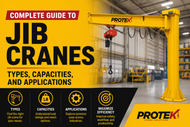
A jib crane is one of the most versatile and cost-effective lifting solutions for manufacturing and maintenance operations. Unlike a full overhead bridge crane, a jib crane serves a specific work zone such as a machining cell, loading dock, or assembly station, and does so with minimal infrastructure and installation cost. If you need efficient, repeatable lifting in a certain area without the expense of a building-wide crane system, a jib crane is worth considering.
The Main Types of Jib Cranes
Wall-mounted jib cranes attach directly to a structural building wall or column. The boom extends outward from the mount and usually rotates through an arc of 180 to 200 degrees. Wall-mounted jibs are ideal when floor space is limited, and the work zone is near a solid structural wall. They do not require a floor foundation, which makes installation easier in many facilities.
Freestanding jib cranes are anchored to the floor with a mast set in a concrete foundation. They can rotate a full 360 degrees, which makes them ideal for open floor areas where wall mounting is not practical. This full rotation allows greater flexibility when loading and unloading at different access points. Installation requires foundation work, but the crane can be placed anywhere in the facility.
Mast-style jib cranes are similar to freestanding models but may use a ceiling tie-back at the top of the mast to increase stability and capacity without needing as deep a foundation. They are a good middle ground for facilities with accessible overhead structures.
Articulating jib cranes have a second pivot point that lets the boom fold or move, which is useful for reaching around obstacles, into machine enclosures, or into spaces where a rigid boom would not fit. They are common in CNC machining environments where the crane needs to reach inside a machine tool.
Weight Capacities
Jib cranes are available in capacities from under 250 lbs up to 5 tons, depending on the design and manufacturer. To choose the right capacity for your application, consider not only the weight of your heaviest load but also the hoist you will use, the typical pick-up radius, and any future load increases you may need to handle.
Never operate a jib crane beyond its rated capacity. The load rating includes dynamic forces during lifting. While a static weight that matches the rated capacity is acceptable, shock or swinging loads can create brief force spikes that exceed the rating.
Indoor vs. Outdoor Applications
Most jib cranes are made for indoor installation. For outdoor use, you need to consider wind load, corrosion protection, and structural footings that can handle both the environmental and lifting loads.
For outdoor or semi-outdoor use, it is important to choose stainless fasteners, galvanized or powder-coated finishes, and sealed electrical components on the hoist.
Common Industries
Jib cranes appear in nearly every manufacturing sector:
- Automotive — engine and transmission removal, tooling changes
- Metal fabrication — positioning plate and bar stock for machining or welding
- Aerospace — precision component handling
- Food processing — ingredient hopper lifting, equipment maintenance
- Maintenance and repair — motor and equipment servicing at fixed maintenance bays
- Loading docks — truck and container loading assistance
Installation Requirements
Wall-mounted jibs require a structural assessment of the mounting surface, as not every wall can withstand the moment loads a jib crane creates. Freestanding jibs need engineered foundation drawings and concrete work sized to the crane’s capacity and mast height. Most manufacturers provide foundation specifications, and a qualified structural engineer should review them. Appearance is also a planning consideration. The rotating boom path must be clear of racking, columns, overhead utilities, and personnel traffic areas at all points in its rotation.
Cost Considerations
Jib cranes are some of the most affordable overhead lifting solutions. A wall-mounted jib with a manual chain hoist can be installed for much less than a full bridge crane system. Electric hoists, motorized rotation, and custom finishes add to the cost but are still affordable for most facilities.
ProTek carries a full range of workstation cranes and crane systems, including Spanco-engineered solutions for operations that need reliable, high-cycle overhead lifting. Contact our team to discuss the right crane configuration for your work zone.