

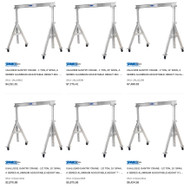
A decade ago, aluminum gantry cranes were a niche product. Today, they are among the fastest-growing segments in the portable lifting equipment market. Facilities seeking flexible, portable lifting solutions without the permanence or expense of a fixed overhead crane find that aluminum gantries meet needs other options do not.
The Core Appeal: Move It Where You Need It
A fixed overhead crane serves only one area. While a steel gantry crane can be relocated, its weight makes this process difficult and infrequent, often requiring additional equipment.
Two people can move an aluminum gantry crane. The frames can be disassembled or rolled on casters, the cross-beam is easily removed, and the entire unit can be repositioned within minutes. For operations with multiple work areas, outdoor maintenance, or frequently changing layouts, this portability significantly increases crane utilization.
Spanco's aluminum gantry crane systems embody this design philosophy: they are lightweight for easy repositioning and engineered to rated capacities for safe, reliable lifting. ProTek's workstation crane catalog features Spanco-built systems for facilities seeking portable overhead lifting solutions.
Weight Without Sacrifice
Buyers often question whether aluminum is as structurally reliable as steel. Within the intended capacity range, aluminum gantry cranes perform reliably. Modern engineered aluminum extrusions are strong, fatigue-resistant, and meet load ratings tested to ASME and OSHA standards.
The primary limitation is capacity. Aluminum gantries are practical for loads up to approximately 2 to 4 tons, depending on the design. For higher capacities, steel is preferred. However, for most maintenance lifting, tooling changes, component removal, and light production tasks, aluminum is sufficient.
Corrosion Resistance
In industries where steel equipment requires frequent painting, rust treatment, or replacement due to environmental exposure—such as food processing, outdoor construction, marine maintenance, car washes, and chemical manufacturing—aluminum's natural corrosion resistance offers a significant operational advantage. It eliminates rust, reduces maintenance painting, and extends service life in environments that would otherwise degrade steel.
Assembly Speed
Many aluminum gantry systems are designed for tool-free or minimal-tool assembly. Crews can assemble and load these systems in less than 30 minutes. This efficiency is especially valuable for construction sites, event staging, and maintenance operations that require rapid deployment and relocation.
Common Applications
- Maintenance shops — engine pulls, equipment servicing, motor replacement
- Manufacturing cells — tooling changes, die sets, fixture loading
- Construction — material positioning, component installation at height
- HVAC and mechanical contractors — rooftop equipment installation
- Automotive — dealership shop lifting, fleet maintenance facilities
- Food processing — corrosion-resistant lifting in wash-down environments
What to Evaluate When Buying
In addition to capacity and height, consider adjustability. Height-adjustable legs enable the gantry to operate in areas with different ceiling heights or outdoors. Locking casters are essential for safety; any wheeled gantry crane must have casters that securely lock under load.
Evaluate the hoist mounting as well. The crossbeam trolley affects how the hoist moves across the span, so confirm compatibility between the beam profile and your trolley or hoist before purchasing.
Explore ProTek's complete crane and material-handling catalog, which includes workstation cranes and Spanco-engineered systems for both portable and fixed overhead lifting applications.