

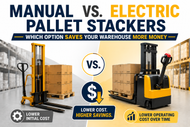
The pallet stacker decision arises frequently in growing warehouse operations. You need to place pallets at racking height, you don't have the aisle width or budget for a traditional counterbalance forklift, and you're evaluating whether to go with a manual hydraulic stacker or step up to an electric unit.
Both options can get the job done, but they suit different types of operations. Here's an honest look at how to compare them.
Purchase Price
Manual hydraulic pallet stackers cost much less upfront, often just a fraction of what you'd pay for a similar electric unit. For small operations with fewer stacking cycles and a tight budget, this price difference is hard to overlook.
Electric pallet stackers have a higher initial investment but include a battery, charger, electric drive system, and powered lift, which substantially change the labor equation.
Comparing purchase prices is just the first step in understanding the total cost.
Labor Savings Over Time
Saving money on labor is usually where electric stackers make the most financial sense for facilities with heavy stacking work.
With a manual stacker, the operator has to pump the hydraulic handle to lift the forks, which takes physical effort and can add up over a shift. At low volumes, like a dozen lifts per day, this isn't a big issue. But at higher volumes—50, 80, or even 100 lifts per shift—operators can get tired. This leads to slower work, more breaks, and a higher risk of injury.
An electric pallet stacker lifts and lowers loads with the push of a button. The operator needs to steer and position the stacker. Lift cycles are faster and stay consistent throughout the shift, with almost no physical strain on the operator. In busy warehouses, the savings in labor costs and the boost in productivity usually offset the higher price within one or two years.
Productivity Comparison
Cycle time matters when you're measuring throughput. An electric unit raises forks faster and with less total operator time per lift. In a receiving operation processing 200 pallets per shift, the difference in cycle time per lift compounds into meaningful variation in throughput over the course of a full day.
Electric stackers let operators work longer without getting as tired as they would with manual stackers. The amount of work done in the first and eighth hours is much more consistent with an electric unit than with a manual one.
Safety Factors
When stacking at height with a manual stacker, the operator must control the load and pump the hydraulics simultaneously. This is a more complicated physical task and can lead to instability. Electric stackers have powered lift and lower controls, so the operator can focus fully on keeping the load stable and in the right position.
According to OSHA ergonomics guidelines, electric stackers can reduce repetitive physical strain and help prevent musculoskeletal injuries over time. Facilities that track injury rates and workers' compensation costs often see improvements after switching from manual to electric stackers.
Bishamon lift tables work well alongside pallet stackers in receiving and shipping areas. By staging pallets at working height before stacking, you can eliminate the need for low-height manual handling.
Warehouse Size and Layout
Manual stackers are a good fit for small spaces with low daily volume, such as boutique operations, light manufacturing, storage rooms, or situations where a full electric unit would be more than you need.
Electric stackers are worth the investment in larger facilities with high racking and heavy daily pallet movement. Both manual and electric stackers can work in narrow aisles where a counterbalance forklift would not fit.
The Clearest Decision Framework
| Factor | Choose Manual | Choose Electric |
| Daily lift cycles | Under 20–30 | 30+ |
| Racking height | Under 10 feet | 10 feet or above |
| Budget | Limited capital | ROI-based purchasing |
| Operator shift length | Short shifts | Full 8+ hour shifts |
| Injury history | Low risk environment | Reducing strain/injury |
| Floor space | Very limited | Standard warehouse |
ProTek Crane Solutions carries a full range of warehouse and material-handling equipment, including scissor lifts, stackers, and handling solutions for warehouses of every size. Browse our catalog or reach out to our team to find the right stacking solution for your operation.