

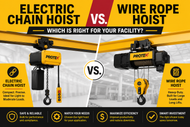
If you are choosing between an electric chain hoist and a wire rope hoist for overhead lifting, it is important to understand the differences between them. While both lift loads and integrate with overhead crane systems, they are designed for distinct applications. Selecting the wrong type can lead to higher maintenance costs, reduced productivity, or early replacement.
Consider the following factors to make an informed decision.
What Each Hoist Is Built to Do
An electric chain hoist uses a load chain as the lifting medium, which passes through a pocket wheel powered by an electric motor and gearbox. Chain hoists are compact, lightweight, and ideal for frequent, short lifts in manufacturing and assembly settings. They are typically used for applications under 5 tons, with lift heights of 20 to 30 feet.
A wire rope hoist wraps a steel cable around a drum to raise and lower loads. The drum design enables much higher lift heights and faster line speeds. Wire rope hoists are the standard choice for heavy-duty industrial applications — steel fabrication, shipbuilding, foundries, and any facility where loads exceed 5 tons or lift heights push past 30 feet.
When a Chain Hoist Is the Better Choice
Electric chain hoists make the most sense when:
- Load capacity is 5 tons or less. Chain hoists are designed for this range and operate efficiently within it.
- Lift height is moderate. In production environments with ceiling heights below 25 feet, chain hoists perform effectively.
- Frequent short lifts are required. Assembly lines, workstations, and maintenance bays often require repeated lifting, which chain hoists are designed to support.
- Budget and space are considerations. Chain hoists are more compact and typically less expensive to purchase and maintain than wire rope units of similar capacity.
- The environment is clean. Chain hoists are suitable for perforated-and-grooved manufacturing settings but are less suitable for foundries, outdoor use, or areas with significant chemical exposure.
When Wire Rope Hoists Outperform
Wire rope hoists are the correct tool when:
- Loads exceed 5 tons. Wire rope handles capacities that chain isn’t engineered to withstand safely.
- Lift heights are substantial. Wire rope drums can accommodate 60, 100, or even 150 feet of lift without the management challenges associated with long chain drops.
- Speed is a priority. Wire rope hoists provide variable-speed control and faster lift speeds, increasing throughput in high-cycle production environments.
- The application is heavy industrial. Steel mills, foundries, and fabrication shops often operate in environments that degrade chains over time. Wire rope hoists are more resistant to heat, debris, and chemicals.
- Precision spotting is required. Variable-frequency drives for wire-rope hoists enable precise speed control for setting loads — critical in machining, aerospace, and precision manufacturing.
Duty Cycle Considerations
Many buyers underestimate duty cycle requirements, which can lead to early equipment failure. Hoist duty cycles are classified by ASME (H1 through H4 for chain hoists, with similar categories for wire rope). Ensure the duty cycle matches your actual usage, including lifts per hour, hours per day, and the percentage of rated load lifted regularly.
If you’re unsure where your application falls, talk to a specialist before purchasing.
Maintenance Differences
Chain hoists require periodic inspection of the load chain for wear, stretch, and damaged links. Chain is a consumable — it will eventually need to be replaced, but individual chain replacement is relatively affordable. The pocket wheel and brake also need routine inspection.
Wire rope hoists require regular inspection for broken wires, kinks, and corrosion. Rope replacement is more complex than chain replacement, but wire rope units typically have longer maintenance intervals when used appropriately. Drum, brake, and gearbox inspections are also required.
Both require compliance with ASME B30.16 (overhead hoists) and routine documented inspections per OSHA 1910.179 guidelines.
Which Industries Typically Use Each
| Application | Typical Choice |
| Assembly line / workstation | Electric chain hoist |
| Automotive manufacturing | Electric chain hoist or wire rope |
| Steel fabrication | Wire rope hoist |
| Foundry / forge | Wire rope hoist |
| Maintenance bay | Electric chain hoist |
| Paper mill | Wire rope hoist |
| Warehouse receiving | Electric chain hoist |
| Aerospace precision work | Wire rope hoist with VFD |
ProTek Crane Solutions carries a full range of manual trolleys and hoist travel systems to pair with your hoist selection, including the Harrington ET Mini Trolley for lighter workstation applications. Browse our full hoist and crane lineup at ProTek Crane Solutions to find the right combination for your facility.